
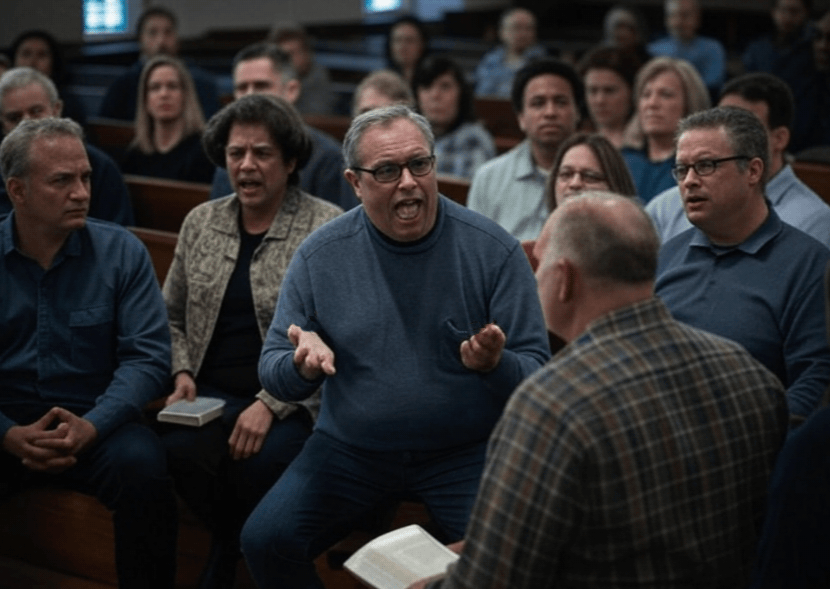
Before Jesus saved me, I was very politically minded and active in both local and national races. My time, energy, and passion were consumed by the political landscape, as I sought to influence policies and elections according to my convictions. But my priorities radically changed when the Holy Spirit entered my life. That’s not to say I no longer have strong convictions about such matters—I do. But my focus shifted when my eyes were opened to Christ and the kingdom of God. Earthly politics, while important, pales in comparison to the eternal reign of Christ and the unity He calls His church to pursue.
Following Christ Above Political Divisions
The church was never meant to be a mirror of the world’s divisions. Yet today, many congregations find themselves fractured over political disputes, often allowing earthly loyalties to take precedence over their allegiance to Christ. This is not a new challenge. The early church, too, wrestled with conflicts between differing perspectives, backgrounds, and cultural expectations. Yet Scripture calls believers to a higher unity—a unity found not in political agreement, but in Christ alone.
Jesus’ Example in a Politically Divided World
Jesus Himself navigated a world rife with political tension. The Jewish people of His day were under Roman occupation, and among them were various factions—Pharisees, Sadducees, Zealots, and tax collectors—each with their own social and political aims. And yet, Jesus did not align Himself with any of these groups. When asked whether it was lawful to pay taxes to Caesar, He responded, “Render to Caesar what is Caesar’s, and to God what is God’s” (Mark 12:17, BSB). He neither endorsed Rome nor joined in a political uprising. Instead, He pointed to a higher allegiance—the kingdom of God.
Unity in Christ, Not Politics
The apostle Paul carried this same theme into the life of the church. Writing to the Ephesians, he urged believers to “walk in a manner worthy of the calling you have received, with all humility and gentleness, with patience, bearing with one another in love, and with diligence to preserve the unity of the Spirit through the bond of peace” (Ephesians 4:1-3, BSB). The call is clear: unity in Christ is not rooted in uniformity of opinion but in shared faith, humility, and love. Disunity is contrary to God’s will, and therefore, it is sin. When we allow divisions to fester, we grieve the Holy Spirit and dishonor the name of Christ.
The Role of Humility in Maintaining Peace
If we are to maintain peace within our churches, we must embrace humility. It is easy to believe that our perspective is the only right one, but Scripture warns against such pride. “Do nothing out of selfish ambition or empty pride, but in humility consider others more important than yourselves” (Philippians 2:3, BSB). Humility is not weakness; it is the very strategy that fosters peace. A church that humbles itself before God and one another will not be quick to divide over political differences but will instead seek to understand, to listen, and to love.
Welcoming Without Compromising Truth
Welcoming those whose views do not align with Scripture presents another challenge. Yet we must remember that the church is not a fortress designed to keep sinners out but a place where sinners are transformed by grace. Jesus sat with tax collectors and sinners, not to endorse their ways, but to call them to repentance and new life. We must do the same, showing kindness without compromising truth. It is possible to love a person while standing firm on God’s Word.
Keeping the Mission Above Politics
Above all, the church must remain faithful to its mission—to proclaim Christ. Political engagement has its place, but it must never overshadow the gospel. Jesus did not commission His followers to make political converts but to make disciples of all nations (Matthew 28:19). The love of Christ must be what defines His people, not their party affiliation.
So, how does this passage speak to you? Are you willing to surrender your earthly loyalties to preserve the unity of the Body? Are you ready to walk humbly, love deeply, and stand firm in truth? The church does not belong to a nation, a movement, or a party—it belongs to Christ. And in Him, true unity is found.
Cross References
- John 17:20-23 (Jesus’ prayer for unity among believers)
- Romans 12:16-18 (Living in harmony and peace with others)
- Colossians 3:12-15 (Putting on love as the bond of perfect unity)
 Learn Christ