
A Transparent Faith: What Made Job “Perfect”?
When Scripture introduces Job, it does so with weighty words that demand reflection. “There was a man in the land of Uz whose name was Job. And this man was blameless and upright, fearing God and shunning evil” (Job 1:1, BSB). That phrase—blameless and upright—does not suggest Job was sinless in the absolute sense. Rather, it points to a man of genuine character in a world given over to appearances and compromise. Job’s “perfection” was not without flaw, but it was free from hypocrisy.
He was not perfect as God is perfect. Yet compared with those around him—some entirely stained by corruption, others merely painted with the brush of religion—Job stood out. His righteousness was not surface-deep; it penetrated to the core. He feared God truly and lived it quietly.
A Tongue That Tells the Truth
Scripture often draws a straight line between the heart and the tongue. Jesus said, “Out of the abundance of the heart, the mouth speaks” (Matthew 12:34, BSB). Job’s speech, especially under trial, revealed a heart shaped by reverence and trust. When tragedy fell, he did not curse. He worshiped. He mourned, but he did not charge God with wrongdoing. His words, even in grief, flowed from faith.
“Shall we accept from God only good and not adversity?” (Job 2:10, BSB). That question echoes down the centuries and still exposes the state of our own hearts. Job didn’t offer perfect theology in every chapter—his laments grew raw—but he never turned his heart against God. That kind of consistency can’t be faked.
A Life That Mirrors the Heart
Job’s actions stood as an open testimony. He was generous to the poor, just in his dealings, and faithful in intercession. “I was eyes to the blind and feet to the lame,” he says later (Job 29:15, BSB). That kind of life doesn’t emerge overnight—it is the fruit of walking with God in private long before anyone is watching.
In Job 31, he recounts a litany of moral choices: covenants with his eyes, care for his servants, honesty in business, compassion for the needy. This wasn’t a man who merely performed righteousness; he pursued it. And when temptation came, he fled from it—not for fear of consequence, but because he feared God Himself.
When Friends Doubt What God Affirms
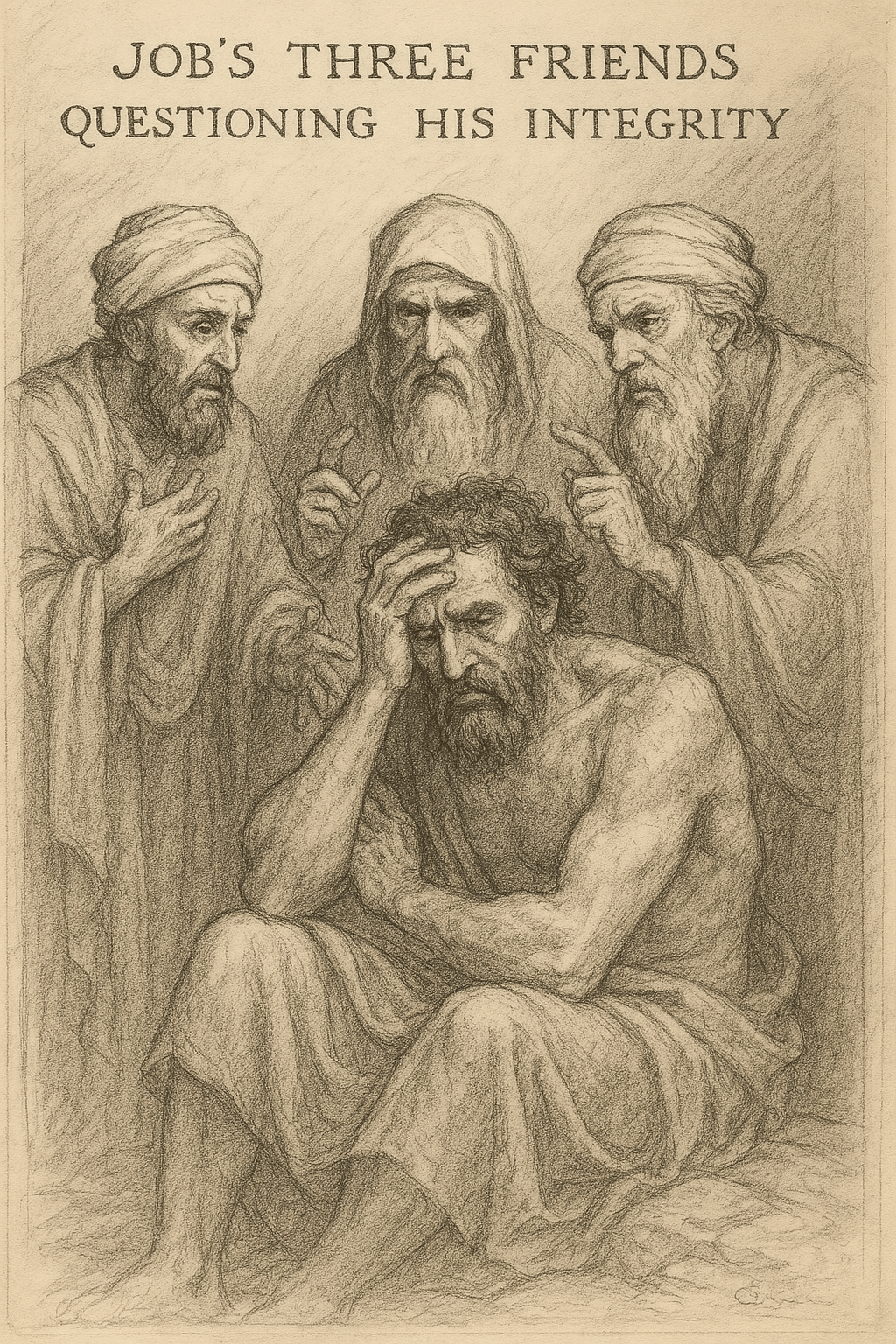
Yet even with such integrity, Job’s friends did not believe him. They sat in silence at first—struck by his suffering—but before long, they began to speak, and their words cut deep. Eliphaz, Bildad, and Zophar took turns insisting that Job must be hiding some great sin. “Surely God does not reject the blameless man,” Bildad said, “nor will He strengthen the hand of evildoers” (Job 8:20, BSB). Their reasoning was clear: since Job’s suffering was great, his guilt must be also.
But they were wrong. These friends, with all their religious language, could not grasp that a man could suffer deeply and still be righteous before God. Their view of justice was narrow and transactional—do good and receive good, do evil and suffer. But Job’s situation defied their theology. And so rather than adjust their understanding, they questioned Job’s integrity.
How painful that must have been. When your world collapses and your friends imply that you deserve it—that you brought it on yourself—that is a deep wound. But Job did not yield. He maintained his innocence, not from pride, but from truth. He knew his standing before God was not based on a hidden sin, and he clung to that even when everyone around him doubted.
God, in the end, vindicated Job. “You have not spoken the truth about Me, as My servant Job has” He told the friends (Job 42:7, BSB). The one they accused was the one God defended.
Painted Religion or Heart-Level Integrity?
We live in a time when it’s possible to present a polished exterior while nurturing rot within. Job reminds us that God doesn’t weigh our public performance but examines the heart. He sees through painted piety. He’s looking for integrity that runs all the way down.
A blameless man or woman is one whose life doesn’t shift with the wind. It is someone whose worship holds steady even when the blessings are stripped away. That kind of authenticity doesn’t come by accident—it comes by cultivating a holy fear of God day after day.
What About You?
Friend, how does Job’s life speak to you today? When suffering comes, what rises from your heart? Do your words echo bitterness or belief? Does your life preach one thing while your soul whispers another?
Job shows us the kind of faith that doesn’t just survive affliction—it speaks through it. His was not a life without hardship, but it was one that honored God through every season. May that be true of us as well.
Cross References:
“Who may ascend the hill of the LORD? Who may stand in His holy place? He who has clean hands and a pure heart…” (Psalm 24:3–4, BSB)
“For we are not like so many who peddle the word of God for profit. On the contrary, in Christ we speak before God with sincerity, as men sent from God” (2 Corinthians 2:17, BSB)
“Better is the poor man who walks with integrity than the rich man whose ways are perverse” (Proverbs 28:6, BSB)
“A man’s integrity guides his way, but the perversity of the wicked destroys them” (Proverbs 11:3, BSB)
 Learn Christ